Piano Academy 2026: Brand Matching and the value of data in action
In Amsterdam, Raphael Stuyck joined Piano and Ads&Data on stage to show how IPM Group uses a private language model and Piano Audience to target campaigns, and why a person still validates every recommendation.
On 6 and 7 October 2026, Piano brought its customers and partners together at the Beurs van Berlage in Amsterdam for the fifth Piano Academy, under the theme “Navigate What’s Next: Driving Monetization in the Age of AI”. Over two days, keynotes by Scott Woody (Metronome, now part of Stripe) and Max Schrems (noyb) framed a programme on pricing, subscriptions, privacy, analytics and AI.
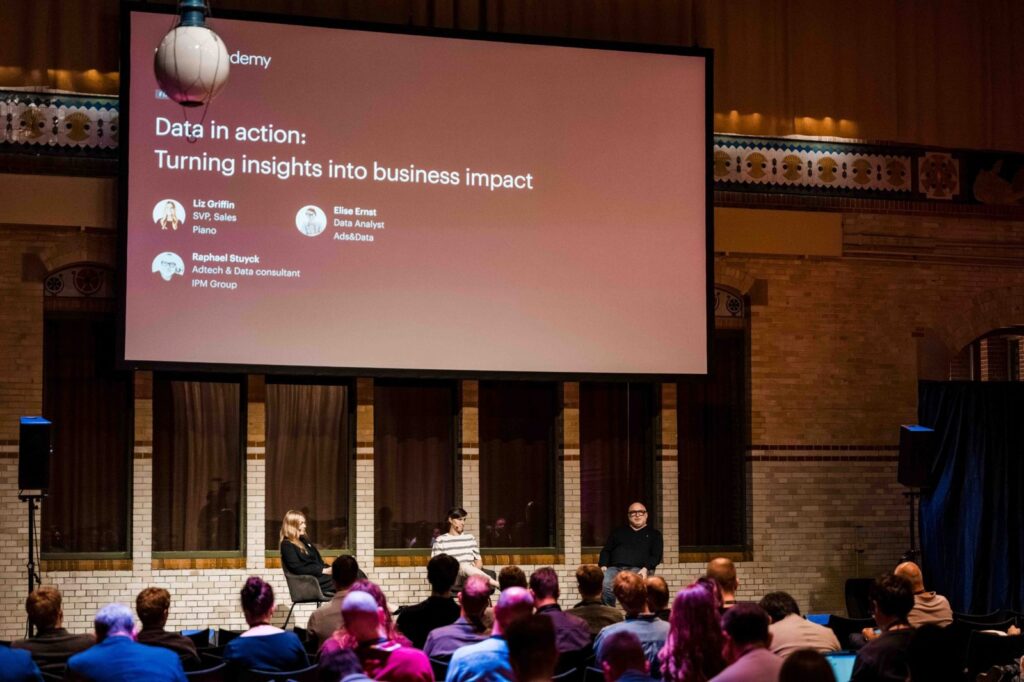
Raphael Stuyck, co-founder of KASIS, took part in the panel “Data in action: Turning insights into business impact” as adtech and data consultant for IPM Group. He shared the stage with Elise Ernst, data analyst at Ads&Data, in a conversation moderated by Liz Griffin, SVP Sales at Piano. Two Belgian media companies, two very different projects, and the same question: what does data actually change in the way you sell and run campaigns?

Brand Matching: from a brand to the right signals
Raphael presented Brand Matching, a tool he built for IPM Group. It connects a private language model to Piano Audience, the data platform that describes IPM’s audiences and articles.
The starting point is an advertiser brief, or simply a brand. Rather than asking a sales or ad-ops team to browse thousands of possible topics, concepts, categories, keywords and companies by hand, the model explores them and suggests the ones that fit the brand. For each signal it gives a confidence score and a short explanation of why it was chosen. It can only pick values that really exist in the platform, so nothing is invented.
Then a person decides. Every recommendation is reviewed and validated before the segment is created and pushed to the ad server. For Raphael, that human step is not a formality: it is what makes the system trustworthy for sales teams and advertisers.
Tested on a real campaign
Brand Matching was put to the test on a video campaign for Red Bull, run with the agency Kineso. The contextual segment was compared with classic age-based targeting, with the same creatives and placements. It cut the cost per completed view by around 40% and improved the completion rate, and click-through improved as well. Read the full case.

What comes next: Brand Matching 2.0
The next version widens the field. Brand Matching 2.0 is designed to combine contextual signals with behavioural and first-party data, Piano Analytics, and the results of past advertising campaigns. The idea is to let the model work through far more signals than any planner could review by hand, and to learn from what actually performed, while people keep the final say.
Our takeaways
- Decisions should come from evidence. Both projects on stage replaced intuition with something measured. Targeting choices, like yield choices, improve when they are tested against real results.
- Data is worth what you do with it. Collecting it is no longer the hard part. The value appears when it changes a decision: which pages, which audience, which price.
- AI proposes, people decide. A language model is very good at exploring a large space of signals and explaining its choices. Checking its proposals against the platform’s own data, and having a person validate them, is what makes it usable in production. More on keeping AI under control.
Thanks to Piano for the invitation, and to Liz Griffin and Elise Ernst for the conversation.
Sources
- Piano Academy, Piano.
- Piano Academy agenda features Scott Woody and Max Schrems, GlobeNewswire, September 2026.